




CSRD Directive in Logistics
Table of contents
- What is the CSRD Directive and who does it affect?
- Why logistics real estate is key to CSRD
- Scope 1, 2 and 3: The CO₂ Footprint of Warehouse Logistics
- Contract Logistics under CSRD Pressure: Data Transparency as a Duty
- "Green leases" and ESG data: What tenants have to demand
- Facts, figures, data: The reality of logistics real estate
- FAQ: Frequently asked questions about CSRD in the logistics hall
- Conclusion: Regulatory duty becomes a competitive advantage
What is the CSRD Directive and who does it affect?
With the gradual introduction of the Corporate Sustainability Reporting Directive (CSRD), the European Union has fundamentally changed the rules of the game for the economy. Around 50,000 companies in the EU will be required to report in the coming years and will have to disclose their sustainability efforts. The directive requires not only vague declarations of intent, but hard, data-based key figures in the areas of environmental, social and governance (ESG). For the logistics industry, especially in the warehouse logistics and contract logistics segments, this means a massive paradigm shift that completely redefines the requirements for space and service providers.
Why logistics real estate is key to CSRD
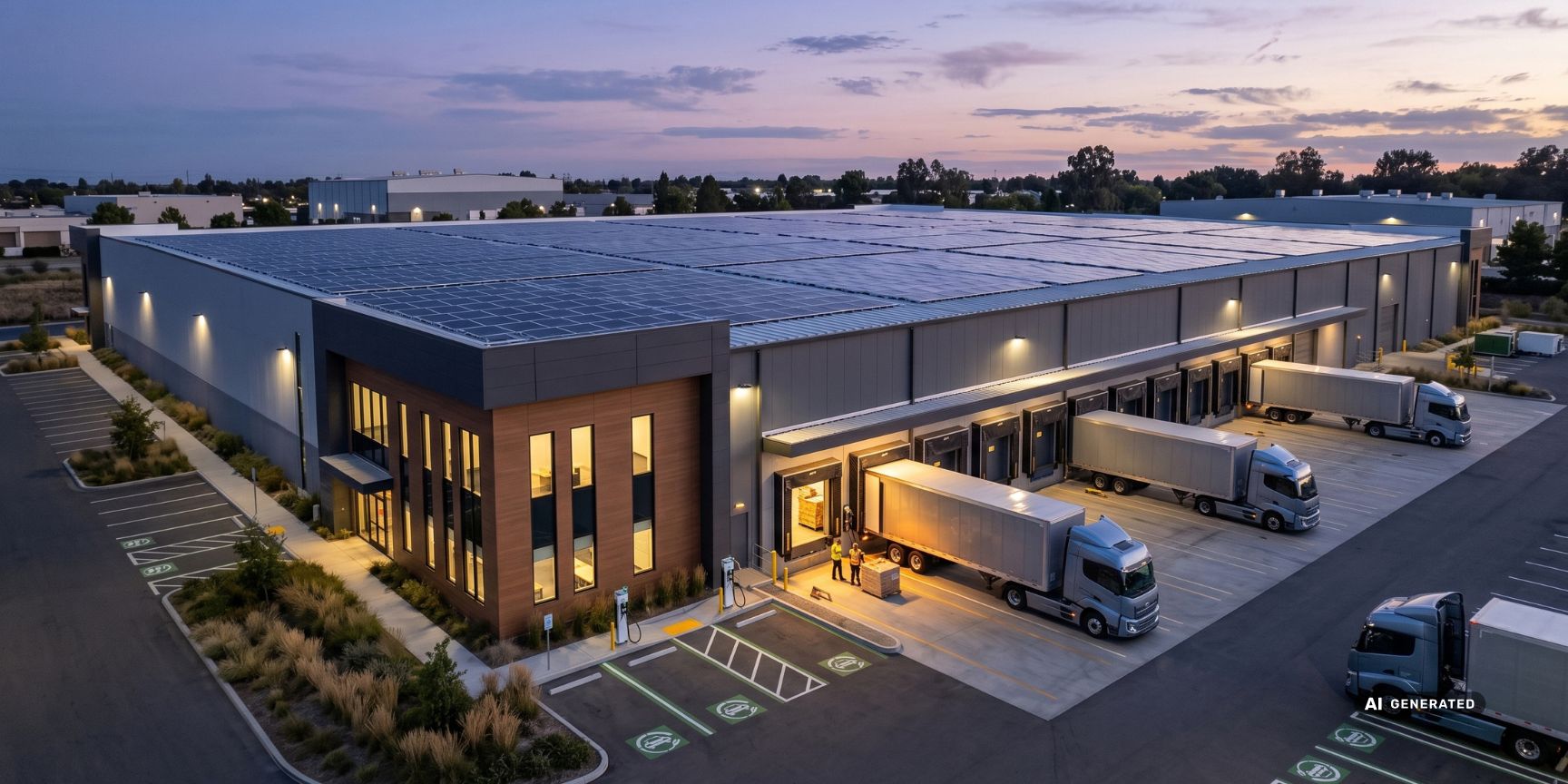
When industry and trade have to balance their emissions, the warehouse inevitably becomes the focus of consideration. Buildings are responsible for around 40% of energy consumption and 33% of greenhouse gas emissions worldwide. As a tenant of a logistics property, if you do not receive reliable and accurate data from your landlord, you simply cannot meet your own legal reporting obligations. This is leading to a new dynamic in the market: the landlord is transforming from a pure space provider to an absolutely necessary data and ESG partner.
Scope 1, 2 and 3: The CO₂ Footprint of Warehouse Logistics
In order to precisely measure the environmental impact in the logistics hall and to map it in compliance with CSRD, greenhouse gas emissions are divided into three categories ("scopes") according to the international Greenhouse Gas (GHG) Protocol:
- Scope 1 (direct emissions): If the tenant operates his own gas-powered radiant heaters or a fleet of diesel-powered industrial trucks in the hall, these emissions fall directly into Scope 1.
- Scope 2 (indirect emissions): The purchase of electricity – for example for hall lighting, cooling technology or automated intralogistics (e.g. AutoStore) – counts as Scope 2.
- Scope 3 (upstream and downstream emissions): This area is the most complex and often accounts for 80 to 90% of the total CO₂ footprint for logistics companies and retailers. This includes, among other things, "embodied carbon", i.e. the emissions generated during the construction of the hall through the production and transport of materials such as steel and concrete.
Contract Logistics under CSRD Pressure: Data Transparency as a Duty
In modern contract logistics, retailers and manufacturing companies often outsource their physical warehousing completely to specialized external service providers. What is highly efficient from a business and operational point of view shifts the climate-relevant emissions completely into the Scope 3 of the commissioning company (in the category of transport and distribution). The contract logistics provider thus becomes a direct data supplier. If it cannot provide a clean emissions balance and exact consumption data for its hall, it endangers the ESG compliance of its customers.
"Green leases" and ESG data: What tenants have to demand
The management of a hall causes considerable costs and emissions. In order to meet the CSRD requirements, classic leases (such as NNN leases), which often suffer from the so-called user-investor dilemma ("split incentive"), are increasingly being replaced by "green leases". Tenants must contractually secure structured data transfers. This includes, among other things, monthly electricity and gas consumption for Scope 1 and 2 as well as data on the circular economy. According to the CSRD ESRS E5 standard, tenants must, for example, provide precise information about the amount of waste generated in tons and the respective recycling rates at the site.
Facts, figures, data: The reality of logistics real estate
The road to a fully CSRD-compliant real estate portfolio is still long. The "NEO Logistics Impact Report" reveals that an alarming 94% of the halls surveyed still generate their heat from fossil fuels (such as gas radiant heaters). At the same time, despite huge roof areas, only 40% of investor halls have photovoltaic (PV) systems. The energy upgrade, for example through DGNB or BREEAM certifications (including PV, heat pumps and LED), increases the initial construction costs (CAPEX) by an estimated 3 to 8 percent, but drastically reduces the ongoing operating costs (OPEX) and prevents buildings from becoming unrentable "stranded assets".

FAQ: Frequently asked questions about CSRD in the logistics hall
Question: As a tenant, can I legally force the landlord to hand over ESG data?
Answer: So far, there is no direct civil law obligation in standard tenancy law in Germany that forces the landlord to hand over detailed CO₂ data if this has not been contractually agreed. The CSRD obliges you as a company to report on why green leases are so vital for new contracts.
Question: What happens if my contract logistics provider does not provide me with real consumption data?
Answer: If primary data is missing (such as exact electricity consumption from sub-meters), the CSRD allows the use of plausible estimates or benchmarks (secondary data) in exceptional cases. These worst-case scenarios are usually much worse than real data and artificially worsen your own sustainability balance.
Question: Are older halls (brownfields) generally a disadvantage under the CSRD?
Answer: Not necessarily. Although uninsulated existing buildings often cause more emissions during operation (Scope 1 and 2), the "grey energy" (Scope 3) was created by the construction years ago and is usually depreciated on the balance sheet. A smart energy-related revitalisation (e.g. new heating technology, PV roof) can even have a better CO₂ balance over the life cycle than a completely new building on a greenfield site.
Conclusion: Regulatory duty becomes a competitive advantage
The CSRD guideline no longer tolerates excuses in logistics and is forcing the industry to achieve unprecedented professionalization. Logistics real estate has long since ceased to be just passive shells made of trapezoidal sheet metal, but highly active levers in strategic climate management. Those who proactively adapt their warehousing today, rely on technologically upgraded halls and offer customers complete data transparency will turn this regulatory obligation into a massive competitive advantage.

Your Ideal Logistics Warehouse
Browse listings for warehouse space, logistics real estate, industrial land, and contract logistics solutions.
Browse Exposés
Maximize Exposure for Your Warehouse Space
Showcase your logistics properties and attract qualified inquiries.
Discover Products