




Reachstackers in warehouse logistics
Table of contents
- What is a reachstacker and how does it work?
- The logistics property: Structural requirements for the hall
- Freilager vs. Halle: What is the operational focus?
- Contract logistics: Intelligent outsourcing of special equipment (CAPEX)
- IT integration and intelligent routing
- Facts, figures and figures: KPIs for warehouse planning
- ESG and sustainability in the handling of industrial trucks
- FAQ: Frequently asked questions about reach forklifts and heavy-duty logistics
What is a reachstacker and how does it work?
A reach forklift is a highly specialized industrial truck that, unlike classic forklift trucks, is not equipped with tines, but with special gripping or clamping tools. In heavy-duty and container logistics, this device is primarily known as a reachstacker, which was specially designed for stacking and handling ISO containers. While narrow-aisle forklifts or electric forklifts usually dominate in classic hall logistics, reach forklifts handle extremely heavy, bulky or atypically shaped goods. The enormous dimensions and weights of these industrial trucks have a profound impact on the structural planning of the logistics property and the operational processes of the entire supply chain.
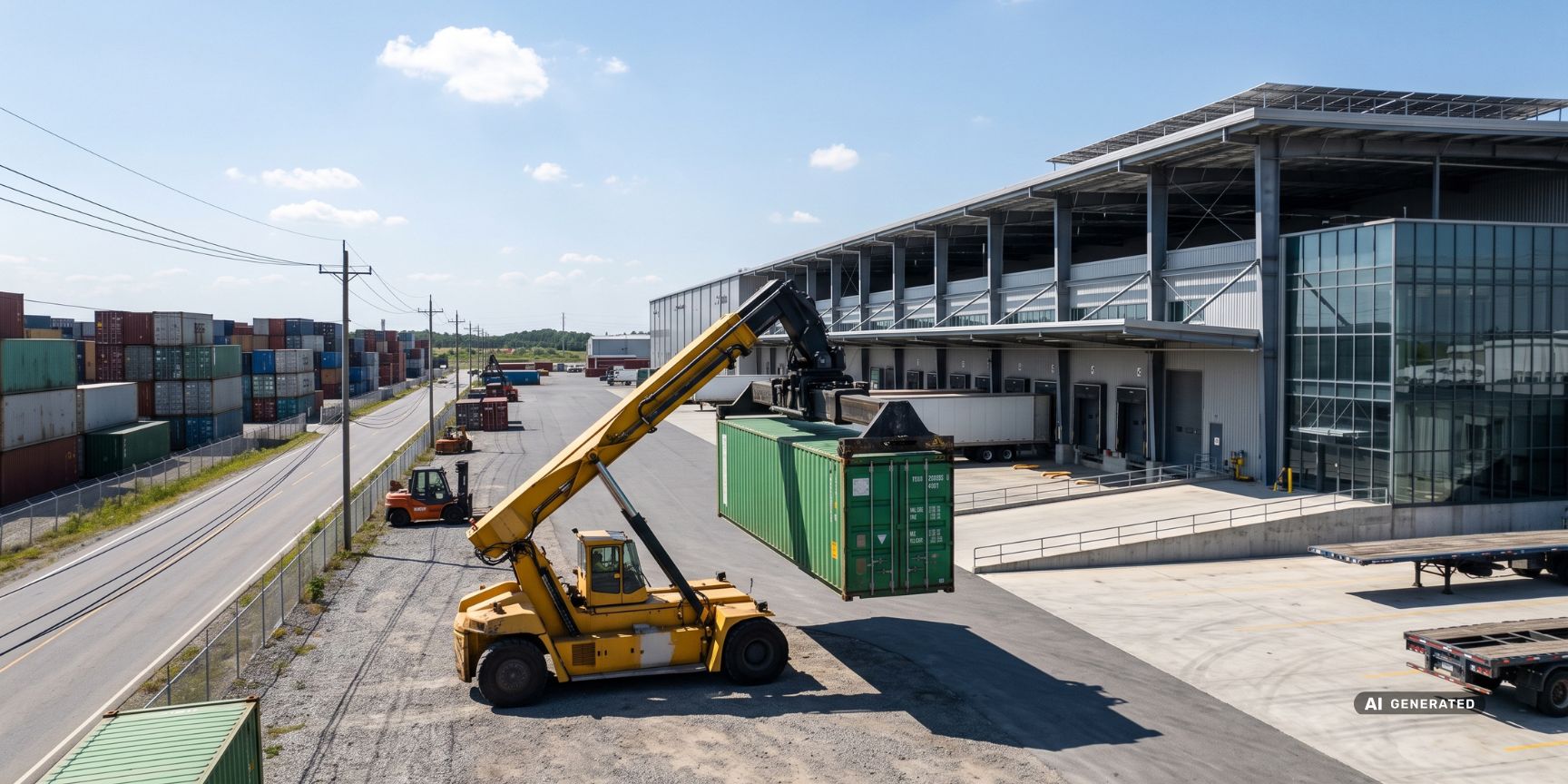
The logistics property: Structural requirements for the hall
The use of heavy industrial trucks such as the reach forklift poses massive challenges for the architecture of a logistics property. The physical nature of the property dictates the efficiency of the entire warehouse logistics.
- Floor load capacity: For driving heavy forklifts and industrial trucks, an industrial floor with a load capacity of at least 50 kN/m² (approx. 5 tonnes per square metre) is absolutely mandatory. However, in a specialised heavy-lift warehouse, where extremely powerful heavy-duty forklifts or reachstackers are used, the high-density special concrete floors must be able to handle surface loads from 10 t/m² to 50 t/m².
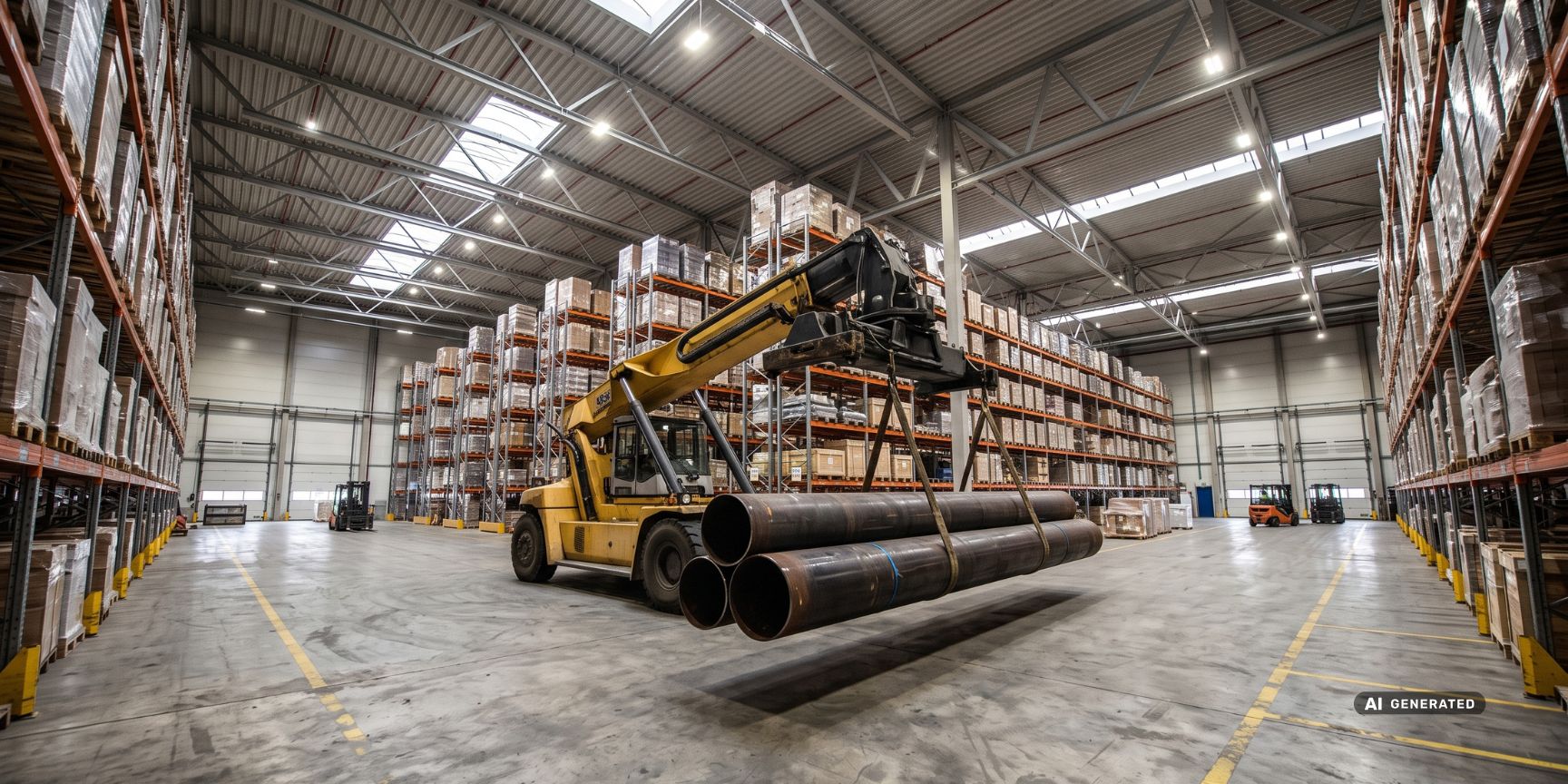
- Clear height (UKB): The standard for modern logistics halls today is 10 to 12 metres lower edge of trusses in order to be able to operate high racks profitably. For the use of large hoists and reach forklifts in heavy goods logistics, however, above-average ceiling heights of 12 to over 15 metres are often essential to ensure sufficient leeway when lifting and turning.
- Door systems: Oversized, widened and raised door systems are a basic prerequisite for being able to load project cargo or ISO containers directly in the hall.
Freilager vs. Halle: What is the operational focus?
Not every good necessarily has to be handled in a closed logistics property. The open-air warehouse places completely different demands on the logistics hardware than classic hall logistics. It is dominated by high-performance electric or diesel heavy-duty forklifts with load capacities of 8 to over 32 tonnes, as well as weather-resistant reachstackers. The massive logistical advantage of the open-air warehouse for the use of reach forklifts is that there is no height limit, so that goods can be stored that do not fit into a standard hall with 10 to 12 metres of UKB. In addition, paved outdoor surfaces often carry the heaviest point loads, at which conventional hall floors would break immediately.
Contract logistics: Intelligent outsourcing of special equipment (CAPEX)
The purchase of heavy-duty reach forklifts and the construction of a heavy-duty commercial property are associated with immense investment costs (CAPEX). Therefore, more and more shippers are opting for strategic outsourcing to an experienced contract logistics provider. In huge multi-user warehouses, synergy effects are fully exploited, as specialist personnel, industrial trucks and the IT infrastructure are shared by different customers. Usage-based rental models (e.g. pay-per-use) can convert high fixed costs into predictable, variable operating costs (OPEX). In addition, modern logistics service providers integrate comprehensive value-added services (VAS) such as quality controls, returns management or pre-assembly into their processes. These value-added services make the warehouse object an active, value-adding component of the supply chain.
IT integration and intelligent routing
A reach forklift only unfolds its full economic potential when it is seamlessly integrated digitally into the hall processes. Modern warehouse management systems (WMS) merge the production units directly with the buffer areas. The system dynamically assigns tasks to each industrial truck and navigates the drivers on the shortest route. This dynamic route guidance reduces the travel times of employees by up to 35%. In addition, mobile devices enable immediate scanning at the point of picking, which typically reduces the error rate during picking to less than 0.1%.
Facts, figures and figures: KPIs for warehouse planning
The use of wide reach forklifts requires wider routes in the hall, which has a direct influence on profitability and key performance indicators (KPIs).
- Degree of land utilization: Classic hall layouts with fixed, wide aisles for heavy trucks often only achieve a space utilization rate of 50 to 60%. The rest of the gross floor area is absolutely necessary for roads, technology and fire protection.
- Proportion of travel time: In poorly planned halls, order pickers and forklift drivers spend up to 60% of their working time just walking or driving.
- Cost advantage of outdoor warehouses: The use of outdoor warehouses for robust heavy goods offers up to 70–80% lower prices per square metre compared to closed hall areas.
ESG and sustainability in the handling of industrial trucks
Growing cost pressure and stricter sustainability requirements (such as the CSRD reporting obligation) are forcing companies to optimize their supply chain in terms of energy efficiency. Modern logistics properties rely on green building certifications (such as DGNB or LEED) to reduce CO2 emissions. Charging electric heavy-duty forklifts and reach forklifts requires a lot of electricity, which is ideally drawn directly from the photovoltaic system on the hall roof. Today, modern simulation tools calculate the exact energy consumption of industrial trucks in order to cap load peaks in a targeted manner and to underpin operation with data support.
FAQ: Frequently asked questions about reach forklifts and heavy-duty logistics
Question: What floor load is required for the use of heavy reach trucks?
Answer: While standard commercial properties often carry only 5 t/m² (50 kN/m²), heavy-duty warehouses require high-density special floors with surface loads between 10 t/m² and 50 t/m² for the use of extremely powerful industrial trucks.
Question: Why is outsourcing to a contract logistics provider worthwhile?
Answer: Those who operate on a project-by-project basis or seasonally benefit massively from an outsourced fulfillment solution. Shippers thus gain access to certified personnel and highly specialized lifting equipment without having to invest in high CAPEX for buildings and machines themselves.
Question: What role does the ceiling height (UKB) play for reach trucks?
Answer: A clear height of 10 to 12 meters is now the industry standard for making optimal use of high-bay systems. However, 12 to 15 meters are often required for the use of reach trucks in project and heavy goods logistics to ensure sufficient vertical clearance for lifting, turning and turning.
💡 Are you currently planning to move into a new logistics property or are you looking for an experienced contract logistics specialist for your demanding equipment? On LAGERflaeche.de you will find future-oriented hall space and the right experts for your next logistics project!
Your Ideal Logistics Warehouse
Browse listings for warehouse space, logistics real estate, industrial land, and contract logistics solutions.
Browse Exposés
Maximize Exposure for Your Warehouse Space
Showcase your logistics properties and attract qualified inquiries.
Discover Products