



AI Hallucinations in Logistics: When AI Plans the Wrong Delivery
Table of Contents
- What is an AI hallucination?
- Why is this particularly relevant in logistics?
- Is bad data a bigger problem than AI hallucinations?
- When does an AI recommendation become dangerous?
- A practical example: the wrong warehouse transfer
- What does meaningful human oversight look like?
- How much autonomy should AI have?
- Who is responsible when AI gets it wrong?
- An AI risk checklist for logistics operations
- The real limit of AI in logistics
AI is increasingly being used to forecast demand, optimize warehouse processes, predict delivery times and support operational decisions. But there is a fundamental limitation that is easy to overlook: AI can produce plausible answers that are factually wrong.
In logistics, that can have consequences far beyond an incorrect chatbot response. A wrong inventory assessment can trigger unnecessary replenishment. An incorrect forecast can lead to the wrong warehouse allocation. An automated recommendation can even cause goods to be moved when they are already reserved for another customer.
So where are the limits of AI in logistics? And how much autonomy should an AI system actually have?
What is an AI hallucination?
The term hallucination is commonly used when generative AI produces information that sounds convincing but is false, fabricated or inconsistent.
The U.S. National Institute of Standards and Technology (NIST) uses the term “confabulation” for this phenomenon. It describes situations in which generative AI confidently produces erroneous or false content.
Imagine an employee asking an AI system:
“How many units of product X are currently available for delivery?”
The system returns 1,200 units.
The answer looks precise. But the actual situation could be very different: 400 units are already reserved, 300 are physically located in another warehouse and the WMS has not yet synchronized the latest stock movement.
The result may look like an AI hallucination. However, not every incorrect logistics decision is actually a hallucination.
This distinction matters.
A generative AI system can invent information. A forecasting model can simply make a bad prediction. An optimization algorithm can work perfectly but receive incorrect input data.
The operational risk is therefore broader than hallucination alone.
Why is this particularly relevant in logistics?
Logistics systems are highly interconnected.
A decision about inventory can affect replenishment. Replenishment affects warehouse capacity. Warehouse capacity affects transport planning. Transport planning affects delivery dates and customer commitments.
This means that a small error at the beginning of a process can propagate through several subsequent decisions.
AI can be used for tasks such as:
- demand forecasting
- inventory analysis
- warehouse slotting
- replenishment planning
- route optimization
- delivery-time prediction
- order prioritization
- warehouse allocation
- capacity planning
But these applications do not all use AI in the same way.
A large language model generating a text recommendation is fundamentally different from a forecasting model predicting demand or an optimization algorithm calculating the most efficient warehouse allocation.
Treating all of these systems simply as “AI” can make risk assessment unnecessarily vague.
Is bad data a bigger problem than AI hallucinations?
In many practical logistics applications, the quality of the underlying data can be just as important — or more important — than the model itself.
Consider a warehouse management system containing:
- outdated inventory figures
- incorrect product dimensions
- missing reservations
- delayed goods-receipt information
- incorrect delivery dates
- inconsistent warehouse identifiers
- incomplete historical demand data
An AI system working with this information may generate a perfectly logical recommendation based on incorrect inputs.
That does not necessarily mean the AI “hallucinated”.
It means the system was asked to make a decision using an unreliable representation of reality.
This is why data quality, data freshness and data consistency have to be treated as part of the AI system itself, rather than as a separate IT issue.
NIST specifically identifies risks associated with confabulation and the downstream use of incorrect AI outputs, particularly where those outputs influence consequential decisions.
When does an AI recommendation become dangerous?
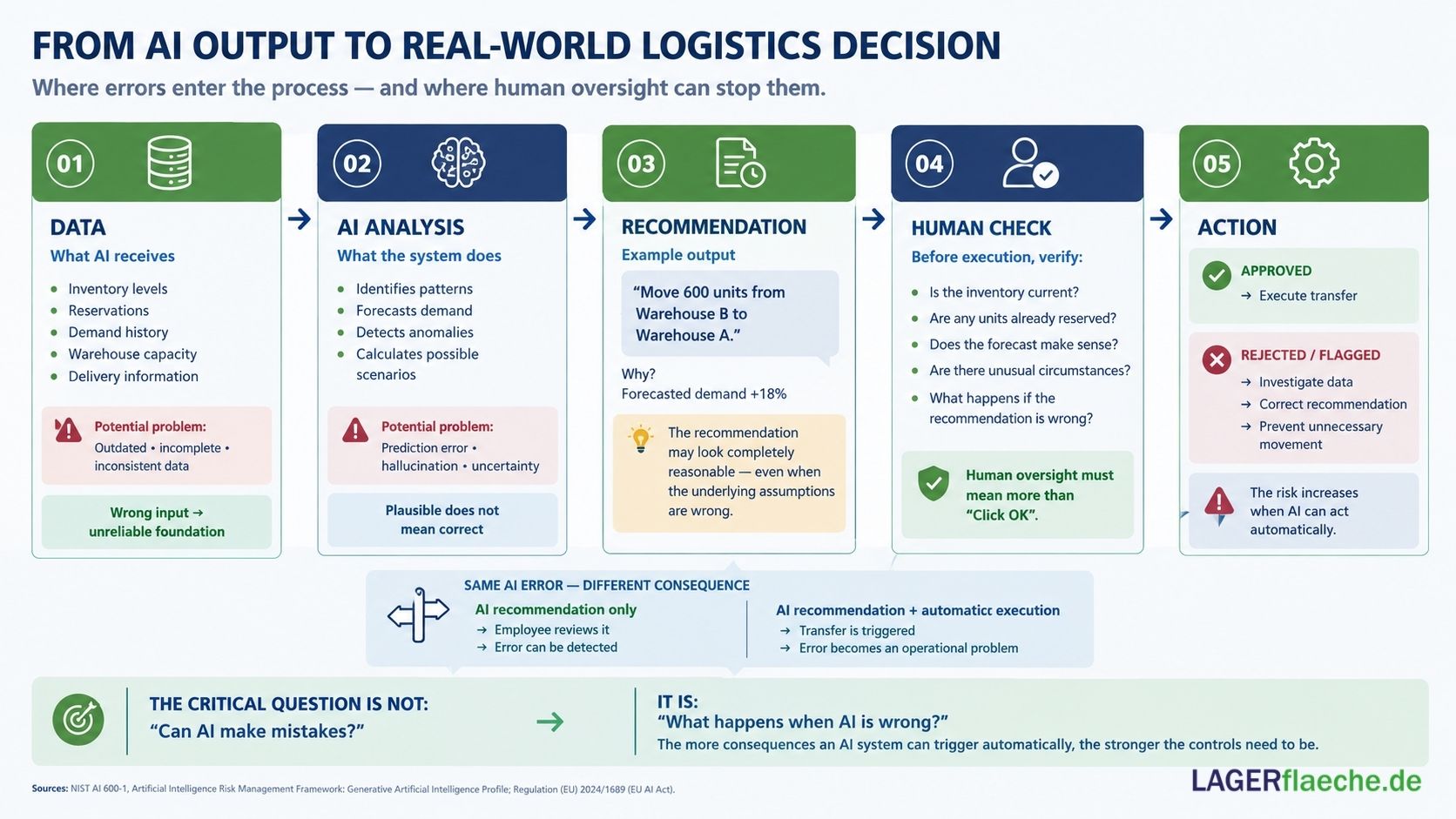
The critical distinction is between recommendation and execution.
An AI system that says:
“Consider moving 600 units from Warehouse A to Warehouse B.”
creates one level of risk.
A system that automatically initiates the warehouse transfer creates another.
The AI may have made exactly the same error in both situations. What changes is the system's ability to act on that error.
This leads to a useful principle for logistics:
The more consequences an AI decision can trigger automatically, the more robust the controls around that decision need to be.
For example, an incorrect demand forecast might initially appear harmless. But if the forecast automatically triggers procurement, replenishment, warehouse transfers and transport bookings, one inaccurate prediction can become a chain of operational actions.
The problem is therefore not simply:
“Can AI be wrong?”
It can.
The more important question is:
“What is the system allowed to do when it is wrong?”
A practical example: The wrong warehouse transfer
Imagine a company operating three warehouses.
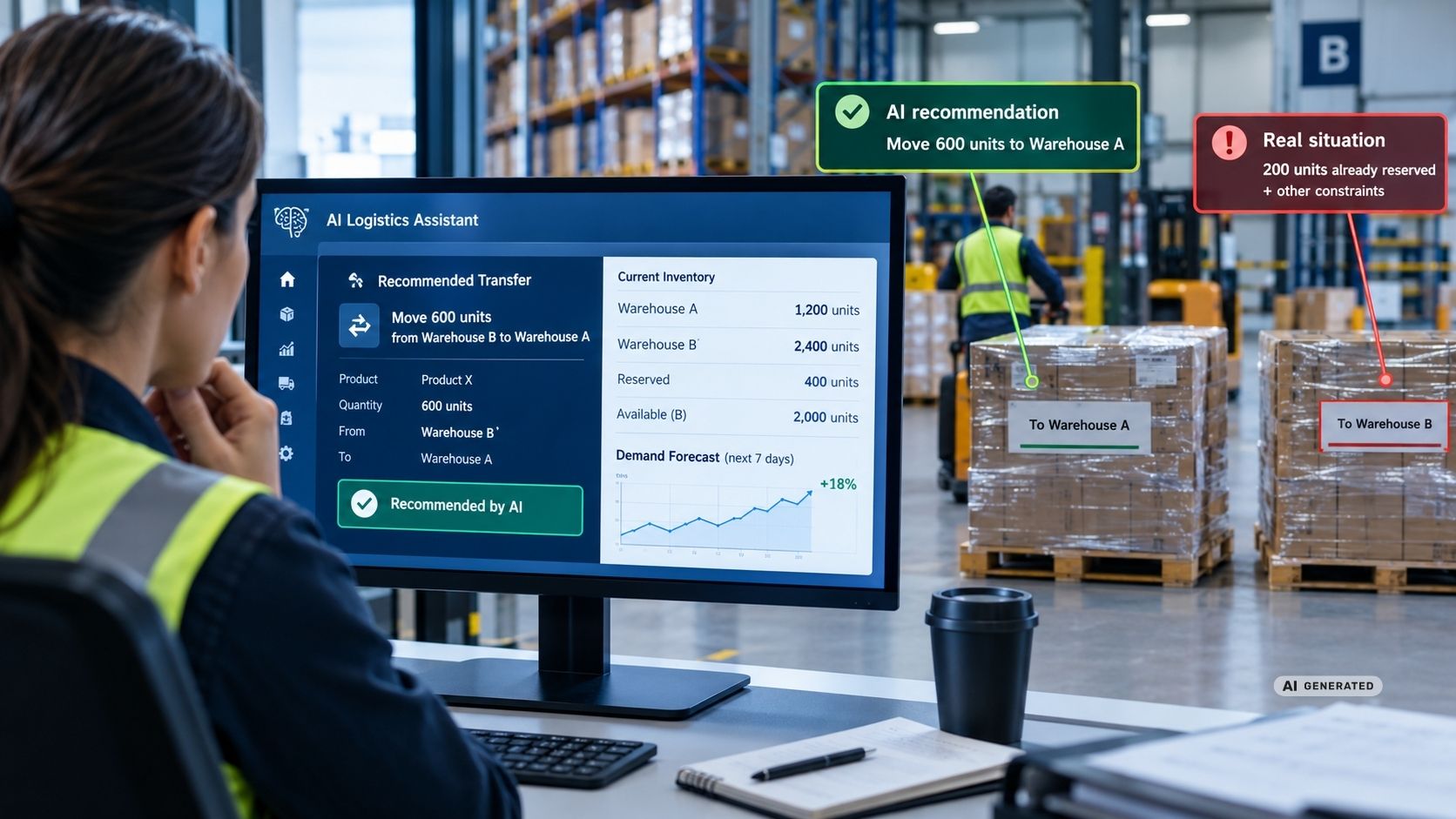
An AI system analyses historical demand and predicts that Warehouse A will experience a shortage within seven days. It recommends transferring 600 units to Warehouse Afrom Warehouse B.
The recommendation looks reasonable.
But several pieces of information were missing:
- a large customer order had been cancelled
- 200 units were already reserved for another customer
- recent demand data had not been synchronized
- an unusual seasonal demand pattern was present
The model therefore combines incomplete information and produces a recommendation that appears plausible.
If a warehouse manager reviews the recommendation and checks the underlying data, the problem can be stopped.
If the system automatically executes the transfer, the error becomes operational.
Warehouse B may suddenly lack stock for an existing order. Warehouse A may receive goods it does not actually need. Transport capacity is consumed. Warehouse staff have to correct the movement.
The important point is that this is not necessarily one single “AI mistake”.
It is a combination of data quality, model uncertainty, business rules and automation.
That is why AI risk in logistics needs to be considered as a complete process rather than as a model-performance problem alone.
What does meaningful human oversight look like?
“Human in the loop” sounds reassuring, but simply putting an approval button in front of an AI recommendation is not enough.
A human needs the information required to question the recommendation.
For a proposed warehouse transfer, that could include:
- the underlying stock figures
- the age of the data
- current reservations
- forecast confidence or uncertainty
- recent unusual demand
- the reason for the recommendation
- the operational consequences
- the option to reject or reverse the recommendation
The person approving the action must also have enough time, authority and knowledge to intervene.
Otherwise, human oversight can become little more than “click OK” automation.
The EU AI Act explicitly addresses human oversight for high-risk AI systems, including the ability of people responsible for oversight to understand system limitations, detect anomalies, override outputs and, where appropriate, stop the system. It also addresses accuracy and robustness requirements.
For logistics operations, the principle is useful even beyond systems that fall within the Act's specific high-risk classifications.
How much autonomy should AI have?
There is no universal level of autonomy that is appropriate for every logistics process.
A practical way to think about it is through four levels.
Level 1 – Analysis
AI analyses data and provides information.
Human: makes the decision.
Example:
“Demand for product X is expected to increase by 18% next week.”
This is generally easier to control because the AI does not directly change the operation.
Level 2 – Recommendation
AI proposes an action.
Human: reviews and approves or rejects it.
Example:
“Move 600 units from Warehouse B to Warehouse A.”
This requires transparent reasoning, current data and meaningful approval.
Level 3 – Conditional automation
AI can execute predefined actions within clearly defined limits.
For example:
“Automatically replenish products when stock falls below the defined threshold, provided that the supplier, budget and delivery parameters remain within approved limits.”
Here, the boundaries become as important as the AI itself.
Level 4 – High autonomy
The system makes and executes decisions with limited human intervention.
This can potentially provide significant efficiency gains, but it also requires substantially stronger monitoring, logging, exception handling, fail-safe mechanisms and clearly defined intervention rights.
The less direct human control there is, the more important it becomes to design the system around predictable failure modes rather than assuming that the AI will always make the correct decision.
Who is responsible when AI gets it wrong?
AI does not take business responsibility for an incorrect warehouse transfer, missed delivery or incorrect inventory decision.
Responsibility has to remain within the organization using the system.
That means defining in advance:
- who approves AI-supported decisions
- which decisions can be automated
- which limits cannot be exceeded
- what happens when data is missing or contradictory
- who monitors model performance
- who can stop automated processes
- how decisions are logged
- how errors are investigated
This is particularly important because an AI system can produce a highly confident answer without actually knowing whether the underlying information is correct.
Confidence in the wording is not the same as confidence in the result.
An AI risk checklist for logistics operations
Before allowing AI to influence an operational logistics decision, companies should be able to answer several basic questions:
- What exactly is the AI deciding or recommending?
- Which data sources does it use?
- How current and complete is that data?
- What happens if the recommendation is wrong?
- Are there plausibility checks or defined limits?
- Can a qualified employee override the result?
- Is every important action logged?
- What happens when information is missing or contradictory?
- Can the process be stopped or reversed?
- Does this task actually require generative AI, or would a deterministic rule or conventional optimization method be more appropriate?
The last question is particularly important.
Not every logistics problem needs a large language model.
For some processes, a clearly defined rule, optimization algorithm or conventional forecasting method may be easier to validate and control.
The real limit of AI in logistics
The most useful question is not:
“How intelligent is the AI?”
It is:
“What happens when the AI is wrong?”
AI can analyze data faster than people, identify patterns across complex datasets and support decisions that would otherwise require significant manual effort.
But those capabilities do not eliminate uncertainty.
A robust AI-supported logistics process therefore needs more than a capable model. It needs a chain of safeguards:
Reliable data → suitable model → validation → plausibility checks → human oversight → defined automation limits → logging → responsibility
That is the difference between simply introducing AI into logistics and building an AI-supported logistics process that can cope with the moment when the system gets something wrong.
Sources
NIST, Artificial Intelligence Risk Management Framework: Generative Artificial Intelligence Profile (NIST AI 600-1).
European Union, Regulation (EU) 2024/1689 – Artificial Intelligence Act, particularly Articles 14 and 15.
Latest Blog Posts
Stay up to date with the newest trends, insights, and tips in warehouse and logistics. Our latest articles help you navigate the industry with confidence.

Data Centres vs. Logistics Facilities: The Race for Power and Land
Across Europe, logistics operators are competing for more than land and transport access. They increasingly need something much harder to secure: grid capacity. Data centres are intensifying that competition — and changing how logistics locations are evaluated....

Chinese companies discover Europe's logistics real estate
Chinese companies are becoming an increasingly visible user group in Europe's logistics real estate market. What does this mean for warehouse space, 3PL structures and the requirements for European logistics locations?...
AI Hallucinations in Logistics: When AI Plans the Wrong Delivery
AI can analyze enormous amounts of logistics data — but it can also produce a convincing answer that is simply wrong. The critical question is not whether AI makes mistakes, but what happens when a wrong recommendation becomes an operational decision....

The Green Revolution on the Hall Roof: From Concrete Block to Ecological Power Plant?
Logistics roofs can do more than PV: greening, bees, urban farming and even sports areas turn unused roof space into multifunctional rooms....